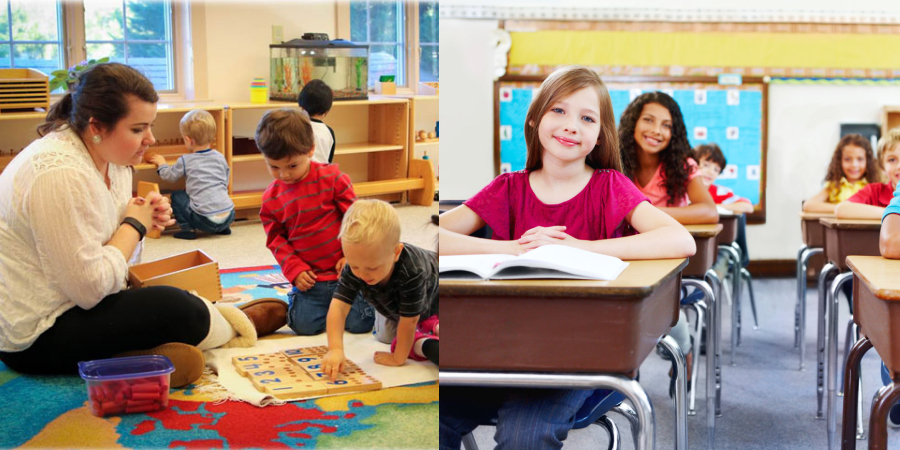

In this article we aim to give you a clear idea of the six differences between Montessori education and traditional education:
| Reason | Montessori | Traditional education |
|---|---|---|
| 1.Practical Vs Theoretical | Methods involve active participation of students with hands-on experience. | Passive involvement of students. Promotes rote learning with no practical learning. |
| 2.Duration | Students are given enough time to understand and grasp the concepts. | Time limitations are set by arbitrary schedules. |
| 3.Curriculum | Classes are planned with students’ needs and requirements in mind. Syllabus is more adaptable. | Classes are based on the prescribed syllabus. Classes are more teacher- centric and predetermined. |
| 4.Role of teachers | Teachers are trained to be on a one-on-one basis with children. They will know the individual capacities of each child and teach accordingly. | Irrespective of the capabilities of the students, the same lessons are taught to all at the same time. |
| 5.Love of learning | Montessori aims at making children love school and its environment. Learning is made to be a fun-filled process. | Traditional education is imparted because it is mandatory to go to school. The curriculum focuses on performance in tests and the grades. |
| 6.Validation | Montessori aims at instilling confidence and self-esteem through personal achievements of the child, however small or big. | In traditional education, only the class toppers are recognized and encouraged to do better. |